Water report
Scanned pages were read and written out below. The original file is unchanged.
06/20/2014 16:36 4107495086
Sharp Water
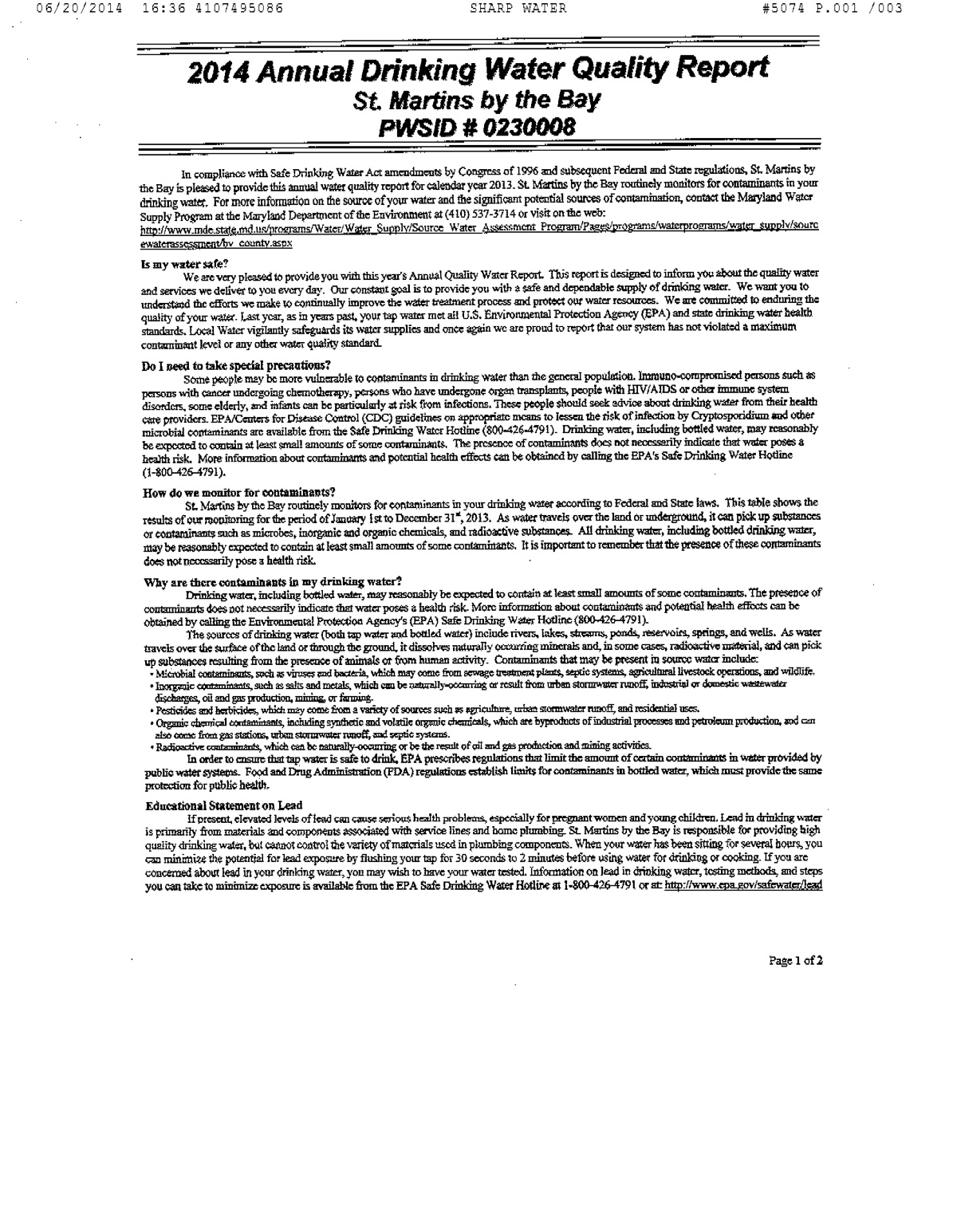
#5074 P.001 / 003 2014 Annual Drinking Water Quality Report St. Martins by the Bay
Pwsid # 0230008
In compliance with Safe Drinking, Water Act amendments by Congress of 1996 and subsequent Federal and State regulations, St. Martins by the Bay is pleased to provide this anmual water quality report for calendar car 2013. St Martins by the Bay routinely monitors for contaminants in your drinking water. For more information on the source of your water and the significant potential sources of contamination, contact the Maryland Watcr Supply Program at the Maryland Department of the Environment at (410) 537-3714 or visit on the web: http://www.mde.state.mdus/programs/Water/Water_Supply/Source Water Asessment Program/Page programs/waterprograTs/ walk_ SUPply/SouT ewaterassessment/hv county.aspx Is my water safe? We are very pleased to provide you with this year's Annual Quality Water Report. This report is designed to inform you about the quality water and services we deliver to you every day. Our constant goal is to provide you with a safe and dependabie supply of drinking water. We waut you to understind the cfforts we make 10 continually improve the water treatment process and protect our water resources. We are committed to enduring the quality of your waiti. Last ycar, as in years past, your tap water met ail U.S. Envirornental Protection Agency (EPA) and state drinking water health standards. Local Water vigilantly safeguards its water supplies and once again we are proud to report that our system has not violated a maximum contaminant level or any other water quality standard. Do I need to take special precautions? Some people mey be more vulnerable to contaminants in drinking water than the general population. Immuno-compromised persons such as persons with cancer undergoing chemotherapy, persons who have undergone orgat transplants, people with HIV/ATDS or other immune system disorders, some elderly, and infants can be particularly at risk from infections. These people should sock advice abort drinking water from their health cate providers. EPA/Centers for Disease Control (CDC) guidelines on appropriate moans to lessen the risk of infection by Cryptosporidium and other microbial contaminants are available from the Safe Drinking Water Hotline (800-426-4791). Drinking water, including bottled water, may reasonably be expocted to contain it least small amounts of some contarinants. The prosence of contaminants docs not necesserily indicate that water poses & heath risk. More information about contaminans and potcatial health efforts catt be obtained by calling the EPA's Safe Drinking Water Hotline (1-800-426-4791). How do we monitor for contaminants? St. Martins by the Bay routinely monitors for contaminants in your drinking watet according to Federal and State laws. This table shows the results of our monitoring for the period of January ist to December 31*, 2013. As water travels over the land or underground, it can pick up substances or contaminants such as microbes, inorganic and organic chemicals, and radioactive substances. All drinking water, including bottled drinking water, may be reasonably expocted to contain at least small amounts of some contamitants. It is important to remember that the presence of these contaminants does not necessarily pose a health risk. Why are there contaminants in my drinking water? Drinking water, including bottled water, may reasonably be expected to contain at least small amounts of some contaminats. The presence of contaminants does not necessarily indicate thzt water poses a health risk. More informstion about contaminents and potential health effoes can be obtained by calling the Environmental Protection Agcacy's (EPA) Safe Drinking Water Hotline (800-426-4791). The sources of drinking water (both tap water and bottled water) inciude rivers, lakes, streams, ponds, reservoirs, springs, and wells. As water travels over the surface of the land or through the ground, it dissolves naturally occurring mincrals and, in some cases, radioactive material, and can pick up substances resulting from the presence of anitals of from human activity. Contaminants that may be present in sourc water include:
- Micrubial contaminats, sach as viruses and bacteria, which may come from servage treatment pises, septic systems, agricultural livestock operations, and wildlife.
- Inorganic contamitants, such as salts and metals, which can be naturally octarring or result thom urben stormuster runoff, indestrial or domestic wastewater
discharges, oll and gas production, mining, or forming.
- Pesticides sad herbicides, which miy come from a varicty of sources such as agriculture, usan stormwater runoti, and residential uses.
- Organic chemical contamitanis, inchiding synthetic and volstile organic chemicals, which see byproducts of industrial processes and petroleum production, and can
aiso comt front gas stations, urbam stormwater runoff, sad septic systiras.
- Raciostive contaminants, which can be naturally-couring or be the repult of oil and gas production and mining activities.
In order to casure that tap water is safe to drink, EPA prescribes regulations that limit the amount of certain contaminants in water provided by public water systems. Food and Drug Administration (PDA) regulations establish littits for contaminants in bottied water, which must provide the same protection for public health. Educational Statement on Lead If present, elevated levels of lead can cause serious health problems, especially for pregnant women and young chikdren. Lead in drinking wate is primarily from materials and components associated with service lines and home plurabing. St Martins by the Bay is responsible for providing hist quality drinking water, buit cataot control the variety of matcrials used in plumbing componens. When your water has been sitting for several bours, you can minimize the potential for lead exposure by flushing your tap for 30 seconds to 2 minutes before using water for drinking or cooking. If you are concerted about lead in your drinking water, you may wish to have your water tested. Information on lead in drioking watcr, toring methods, and steps you can take to minimize exposure is available from the EPA Safe Drinking Water Hotline at 1-800-426-4791 or at: http://www.epa.gov/safcwater/lead Page 1 of 2 06/20/2014 16:37 4107495086
Sharp Water
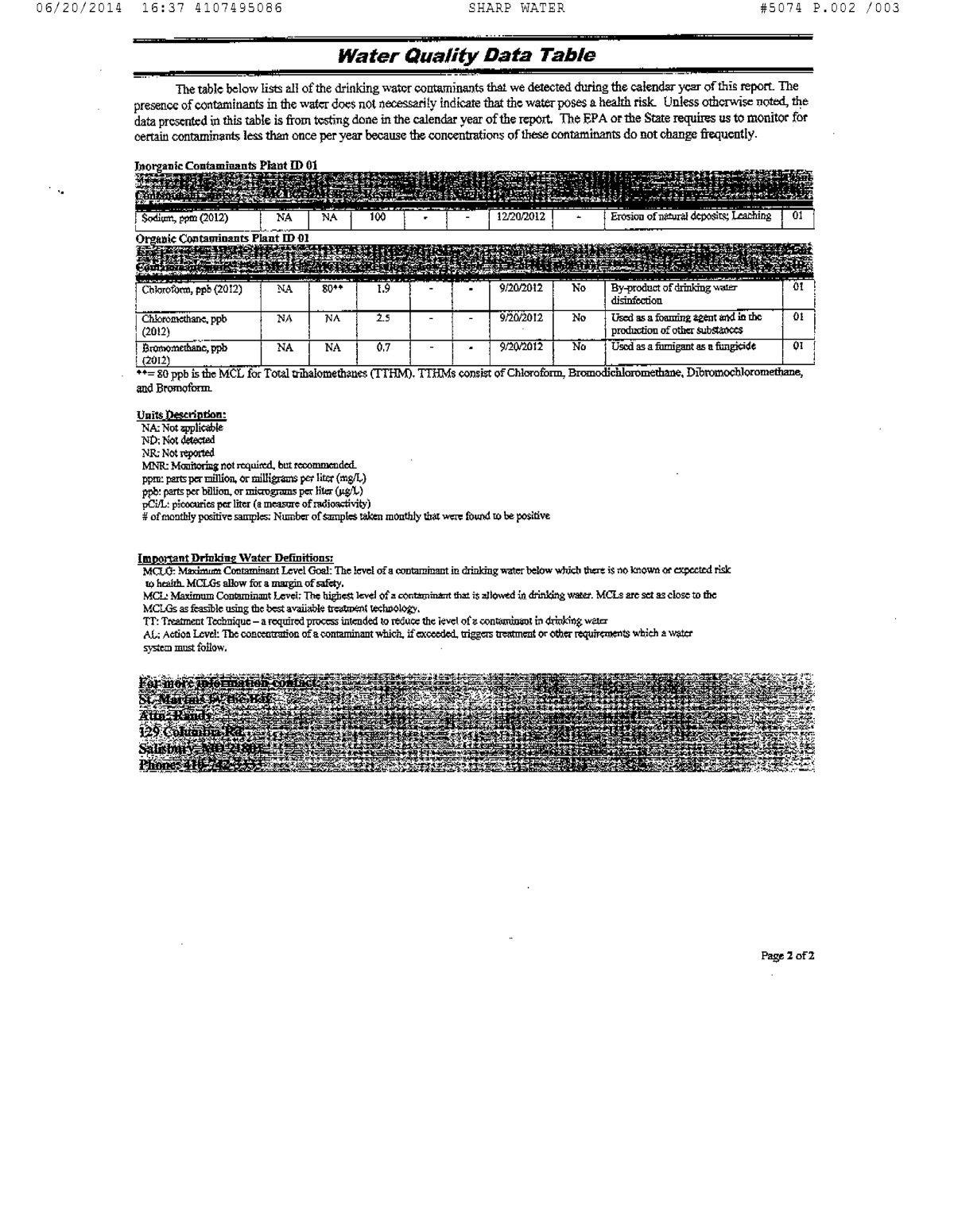
#5074 8.002 / 003 Water Quality Data Table The table below lists all of the drinking water contaminants thai we detected during the calendar year of this report. The presence of contaminants in the water does not necessarily indicate that the water poses a health risk. Unless otherwise notod, the data presented in this table is from testing done in the calendar year of the report. The EPA or the State requires us to monitor for certain contaminants less than once per year because the concentrations of these contaminants do not change frequently. ants Prant ID 01
Sodium, ppm
2012
NA Orgabic Contaminants Plaz nt ID 01 NA 100 12/20/2012 ¡ Erosion of natural deposins; Leaching
Chlorotorto, ppb
2012
NA 80** 1.9 Chloromethanc. ppb NA (2012) NA 2.5 9/20/2012 9/20/2012 Bromotethanc, ppb NA NA 0.7 9/20/2012 No No No By-product of drinking water 01 disinfection Used as a foaring agent and in the production of other substances Usod as a fumigant as a fungicide 01 L(2012)
- = 80 pph is the MCL for Total tribalomethanes (TTHM). TTHMs consist of Chloroform, Bromodichloromethane, Dibromochloromethane,
and Bromoform. Units Description: NA: Not applicable ND: Not detected NR: Not reported MNR: Monitoring not requined, but recommended ppr: parts per million, or milligrams per litcr (mg/L) ppb: parts per billion, or micrograms per liter (u8%) pCi/L: picocuries per liter (a measure of radiosctivity) # of monthly positive samples: Number of samples taken monthly that were found to be positive Important Drinking Water Definitions: MCLO: Maximust Contaminant Level Goal: The level of a contarzinant in drinking water below which thert is no known or expected risk to health. MCLGs allow for a margin of safety. MCL: Maximum Contaminat Level: The highest level of a contaminant that is allowed in drinking water. MCLs are set as close to the MCLGs as feasible using the best avaiiable treatrint technology. TT: Treatment Technique - a roquired process intended to reuce the ievel of a contininot in driking water Al: Action Level: The concentration of a contaminant which, if exceeded, triggers trestment or other requirements which a water system must follow. 125 Cofustra Salisbus Phone 11 Page 2 of 2 06/20/2014 16:37 4107495086
Sharp Water
#5074 P.003 / 003 Maryland Department of the Environment Water Supply Program 1800) 573729, 180-653,810 41 D) • Fax: May 372130
Mde
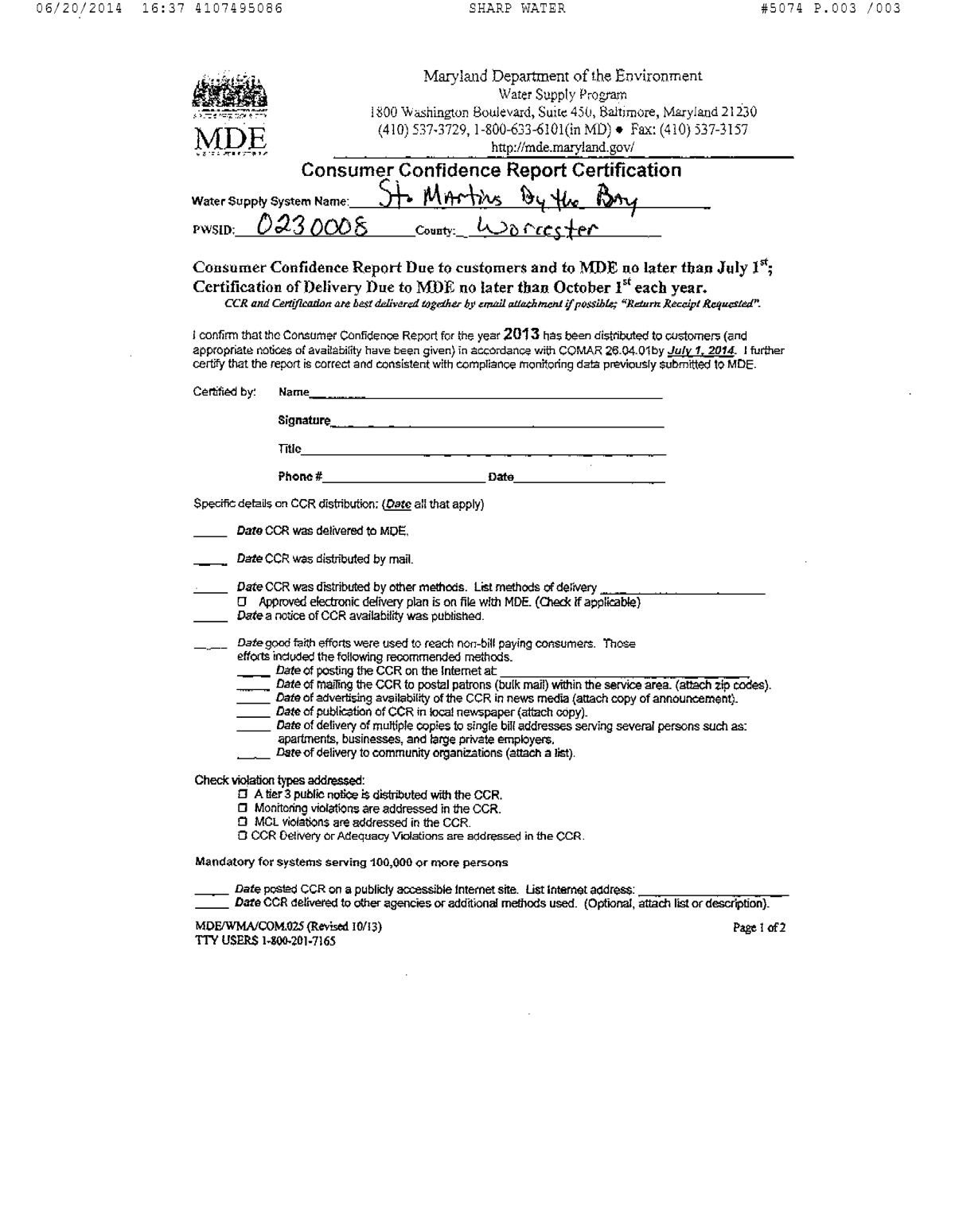
http://mde.maryland.gov/ Consumer Confidence Report Certification Water Supply System Name:
Pwsid
0230008 St- Martins Dy the Bary _County:__ worcester Consumer Confidence Report Due to customers and to ME no later than July 1°; Certification of Delivery Due to ME no later than October I" each year CR and Certification are best delivered together by emuil allachment if possible; "Return Reccipt Requested I confirm that the Consumer Confidence Report for the year 2013 has been distributed to customers (and appropriate notices of availability have been given) in accordance with COMAR 26.04.01by July 1, 2014. I furthe certify that the report is correct and consistent with compliance monitoring data previously submitted to MDE Certified by: Name Signature... Titic Phonc # Date Specific details on CCR distribution: (Date all that apply) Date CCR was delivered to MDE.
- . Date CCR was distributed by mail.
Da Acred electronited yet plan is on file wither chedi apolicable Date a notice of CCR availability was pubtished. Date good faith efforts were used to reach non-bill paying consumers. Those efforts included the following recommended methods. Date of posting the CCR on the Intemet at _ Date of mailing the CCR to postal patrons (bulk mail) within the service area. (attach zip codes). Date of advertising availability of the CCR in news media (attach copy of announcement). Date of publication of CCR in local newspaper (attach copy). Date of delivery of multiple copies to single bill addresses serving several persons such as: partments, businesses, and large private employers Jate of delivery to community organizations (attach a list
- A tier 3 public notice is distributed with the CCR.
- Monitoring violations are addressed in the CCR.
3 MCL violations are addressed in the CCF 3 CCR Delivery or Adequacy Violations are addressed in the CCI Mandatory for systems serving 100,000 or more persons Date poet CR o a bir genes retired net is used. (ara, act list or description). MDE/WMA/COM.025 (Revised 10/13) Page 1 of 2
Official document
These are the original pages. The PDF file is the same document.