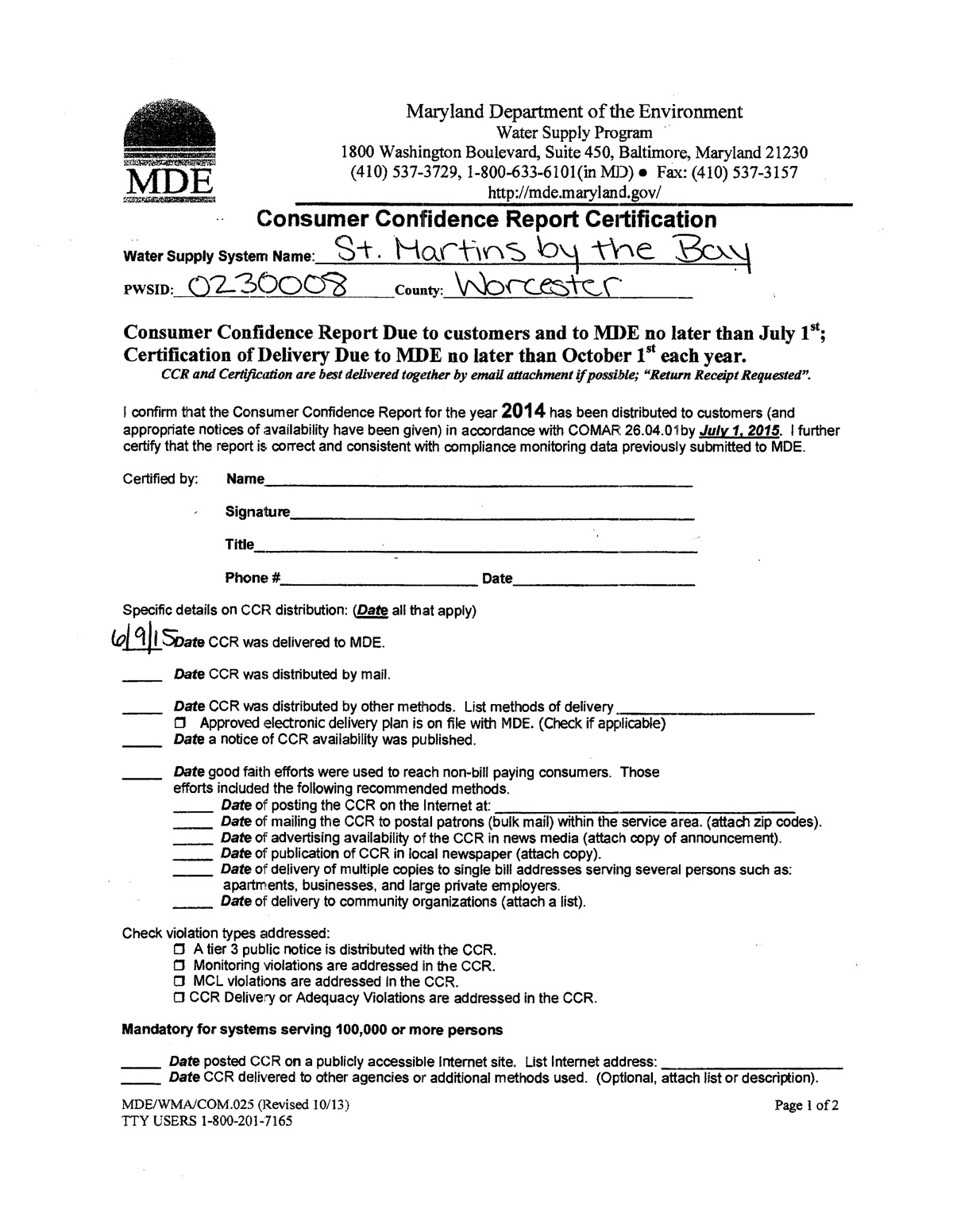
ffi re ru m- ffi MH Maryland Department of flre Environment Water Supply Program 1800 Washington Boulevard, Suite 450, Baltimolg Maryland 21230 (410) 537-3729,l-800-633-6101(in MD) r Fa;r: (410) 537-3157 http://mde.maryl an d. gov/ Consumer Gonlfidence Report Ceftification Water Supply System Name:
.*rto,_O2-?>()O C8__counry:
Consumer Confidence Report Due to customers and to MDE no later than July ltt;
Certification of Delivery Due to MIIE no later than Octobr;r l't each year.
CCR and Ceflifurttion are bat delivered together by email afiachment if possible; nRetwn Receipt Requated'. I confirm ttrat the Consumer Confidence Report for the year 2014 has been distributed to customers (and appropriate notices of ravailabili$ have been givrsp; ;n accordance with COMAFI 26.04.011by Julv 1.2015. I further certify that the report is, conect and consistent vt'ith compliance monitoring data previously submitted to MDE. Certified by:
Signalturc Title Phone # Date Specific details on CCI? distribution: @aEall that apply) blqLSr& ccR was detivered ro MDE.
Dafe ccR wa$ distributed by mail.
Date CCR vras distributed by other metllods. List methods of delivery O Approved relectronic delivery plan is on file with MDE. (Check if apprlicable) Date a notice of CCR availability was published.
Date good feith efforts were used to reach non-bill paying consumers. Those efforts included the following recomrnended methods.
Date o1'posting the CCR on the Intemet at _ Dale o1'mailing the CCR to postal patrons (bulk mail) within the service area. (attach zip codes). __ Dafe o1'advertising availability of the CCR in news media (attach copy of announcement).
Date o1'publication of CCR in loc,al newspaper (attach c-opy).
Date 01'delivery of nlultiple copies to single bill addresses servilrg several persons such as: apartnrents, businesses, and large private employers.
Date ol'delivery to community organizations (attach a list).
Check violation types addressed:
Cl A tier 3 public notice is distributed with the CCR.
n Monitoring'yiolations are addressed in the CCR.
O MCL vlolations are addressed In the CCR.
0 CCR Delivery or Adequacy Violationsr are addressed in the CCR.
Mandatory for systems seruing 100,000 or moie pensons Dafe posted CCR on a publicly accessible Internet site. List Intemet address:
Dafe CCR delil'ered to other agencies or additional methods used. (Optlonal, aftach list or descrifiion). MDE/WMrVCOM.02:t (Revised l0/1 3.r TTY USERS l-800-201-7165 Page I of2
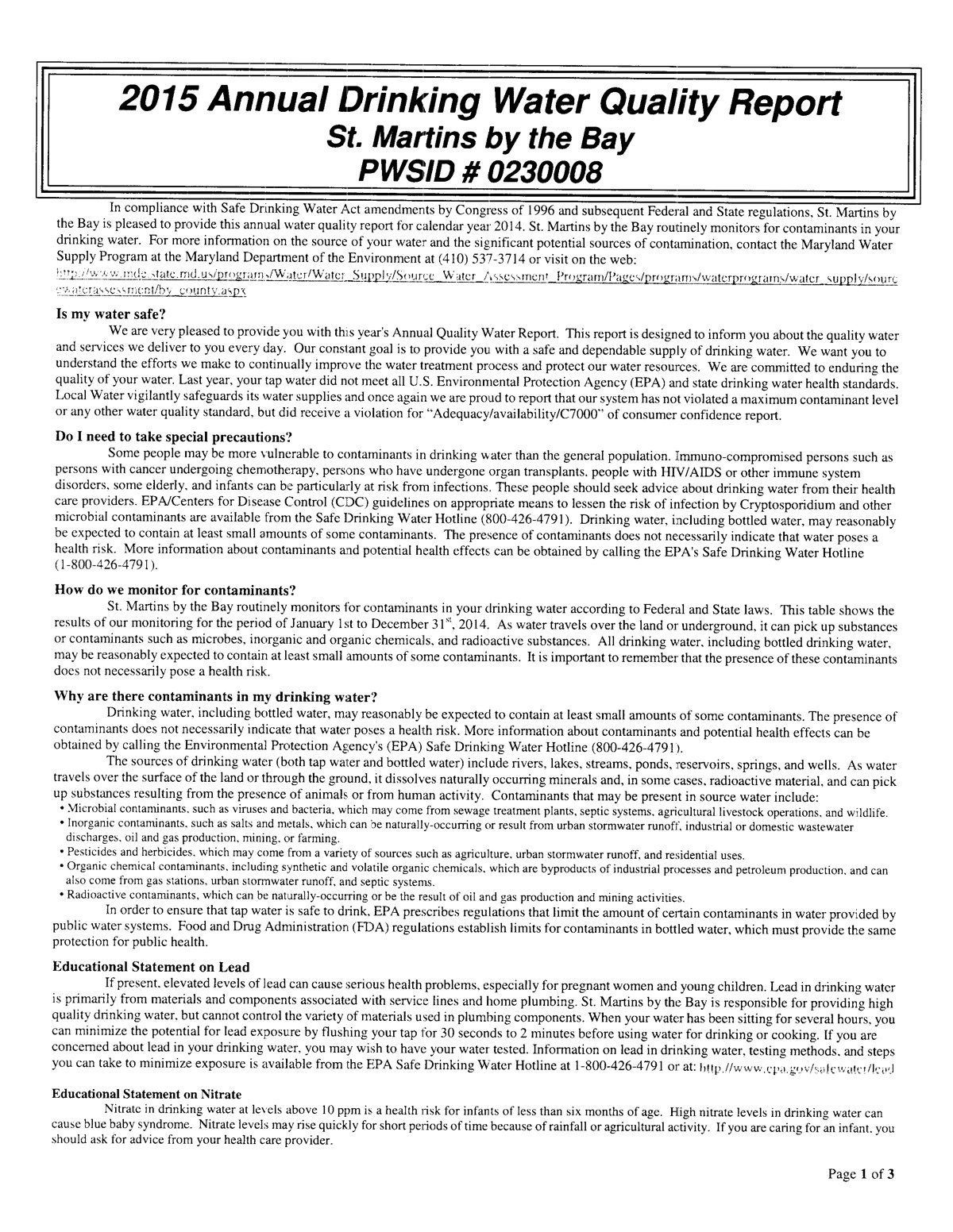
201 5 Annual Drink:ing St. Martins PWSVD # Water Qualirity by the Bay 0%00a8 Report IncompliancewithSafeDrinkingWaterlrctamendmcrrtsbyCongIessofl996*oiuu'e+,.,'tpeo.'@ the Bay is pleased to provide this annual \\,'ater quality report 1br calendar year 2014. St. Martins by the Bay routinely monitors-for contaminants in your drinking water. For more information on the source of I'our water and the sig,nificant potential sources of contamination, contact the Maryland Witer SupplyProgramattheMarylandDepartmentof theEnvironmentat (41U53'7-3T14orvisitontheweb:
itliir.li:--la U]_ii!a!g.nd. urlpr.qrirnr.,/lV;rt,.irlWarg-*!1gql1i{4111X_E{Cr /i5gl:l1etl,f,,qf {! ls my water safe? We are very pleased to provide you with thls year's Annual Quality Water Report. This reporl is designed to inform you about the quality water and services we deliver to you every rJay. Our conslant goal is to provide you with a safe and dependable supply of drinking water. We want you to understand the efforts we mzkc to continrLally improve thc water treatment process and protect our water resources. We are committed to enduring the quality of your water. Last year, your tap water did not meet all U.S. Environnrental Protection Agency (EPA) and state drinking water health standards. Local Water vigilantly safeguards its v/ater supplies iind once again we are proud to report that our system has not violated a maximum contaminant level or any other water quality standard, but did receive a violation fbr "Adequacy/availability/C7OOO" of consumer confidence report. Do I need to take special precautions? Some people may be more vulnerable to contaminants in drinking'"'"ater than the general population. ilmmuno-compromised persons such as persons with cancer undergoing chemotherapy, persl)ns who have undergone organ transplants. people with HIV/AIDS or other immune systenr disordcrs' some elderly, and infants can be'particulady at risk frorn infections. These people should seek advice about drinking water from theil health c;Lre providers. EPA/Centers for Disease Control (CDC) guidelines on appropriate means to lessen the risk of infection by Cryptosporidium and other microbral contaminants zLre available from the Safe Drinking Water Hotline (800-426-4791). Drinking water, i;ncluding bottled *ui"., *uy reasonably be expected to contain ;rt least small amounts of sorrLe contaminants. The presence of contaminants does not ne,cessarily indicate that water poses a health risk. More infonnation about contaminants and polsnlin[ health effects can be obtained by calling the EPA's Safe Drinking Water Hotline ( 1-800-426-4791).
How do we monitor for contaminants? St. Martins by the Bay routinely monitors lbr contaminants in your drinking water according to Federal and State laws. This table shows the resultsofourmonitoringfortheperiodofJanuarylsittoDecember3l",20l4. Aswatertravelsoverthelandolunderground,itcanpickupsubstances or contaminants such as microbes, inorganic and organic chemicails, and radioactive substances. All drinking urater, including bottled drinling water, may be reasonably expected to contain at least small amounts of some contaminants. It is important to remembel that the presence of these contarnrnants does not necessarily pose a health risk.
Why are there contaminants in my drinking water? Drinking water, including bottled water, mily reasonably be expectecl to contain at least small amounts of some contaminants. The presence of contaminants does not necessarily indicate that water poses a healrth risk. More information about contaminants and potential health effects can be obtained by calling the Environmental Prc,tection Ag;encv's (EPA) Safe Drinkrng Water Hotline (800-426-4'791t. The sources of drinking '*'ater (both tap waller and bottlecl water) include rivers, lakes, streams, ponds. reservoirs, springs. and wells. As water travels over the surface ofthe land or through the ground, it dissoll'es naturally occurring minerals and, in some i:ases, radioactive material, and can pick up substances resulting from the presence of animals or from human activity. Contaminants that may be present in source water include: 'Microbial contaminants. such as viruses and bacteria, which may come from sewage treatment plants, septic systems, agricultural livestock operations. and wildlife. ' Inorganic contaminants. such as salts and metals, which can l:e naturally-occurring or result from urban stormwater runofl', industrial or domistic wastewarer discharges. oil and gas production, mining, c,r farming.
' Pesticides and herbicides. which may come from a varie,ty of sources such as agricu)ture. urban stormwater runoff. and residential uses. 'Organic chemical contaminants' including s'ynthetic and volatile organic chemicals. which are byproducts ofindustrial processes and petroleum production. and can also come fiorn gas stations. urban stormwater runoff, and septic systen"N.
' Radioactive contaminants, which can be naturally-occurring or be the result of oil and gas production and mining activities. In ordcr to ensure that tap water is safe to drink, EPA preticribes regulations that limit the amount of ceftain contaminants in water- provrded by public water systems. Food and Drug Administratiorr (FttA) regulations establish limits for contaminants in bottled water, which must provide the same protection for public health.
Educational Statement on Lead If present' elevated levels of I ead can cause serious health problems, especially for pregnant women and young children. Lead in drinking watcr is primarily from materials and conrponents associated with service lines and home plumbing. St. Martins by the Bay is responsible for providing high quality drinking water, but cannot conl.rol the variety of materials used in plumbing components. When your water has been sitting for several houis, you can minimize the potential for lead exposure by flushing your tap fbr 30 seconds to 2 minutes before using water for drinking oicooking. If you are concemed about lead in your drinking watL'r, you may wish to have your watel tested. Information on leacl in drinking water, testing methods, and steps you can take to minimize exposure is available from the tiPA Safe Drinking Water Hotline at 1-8OO-426-4791 or at.lr!!p.//www,,j1,a.glvllllcv;itrr/1,,.i,:l Educational Statement on Nitrate Nitratc in drinking water at levels above I 0 ppm is a health dsk fbr infan ts of less than six months of age. Fitigh nitrate levels in drinking water can causebluebabirsyndrome. NitratelevelsmayrisequickJyforshortpedodsoftimebecauseofrainfalloragriculturalactivity. Ifyouarecaringforininfant.you should ask for advice from your health care provider.
Page I of 3
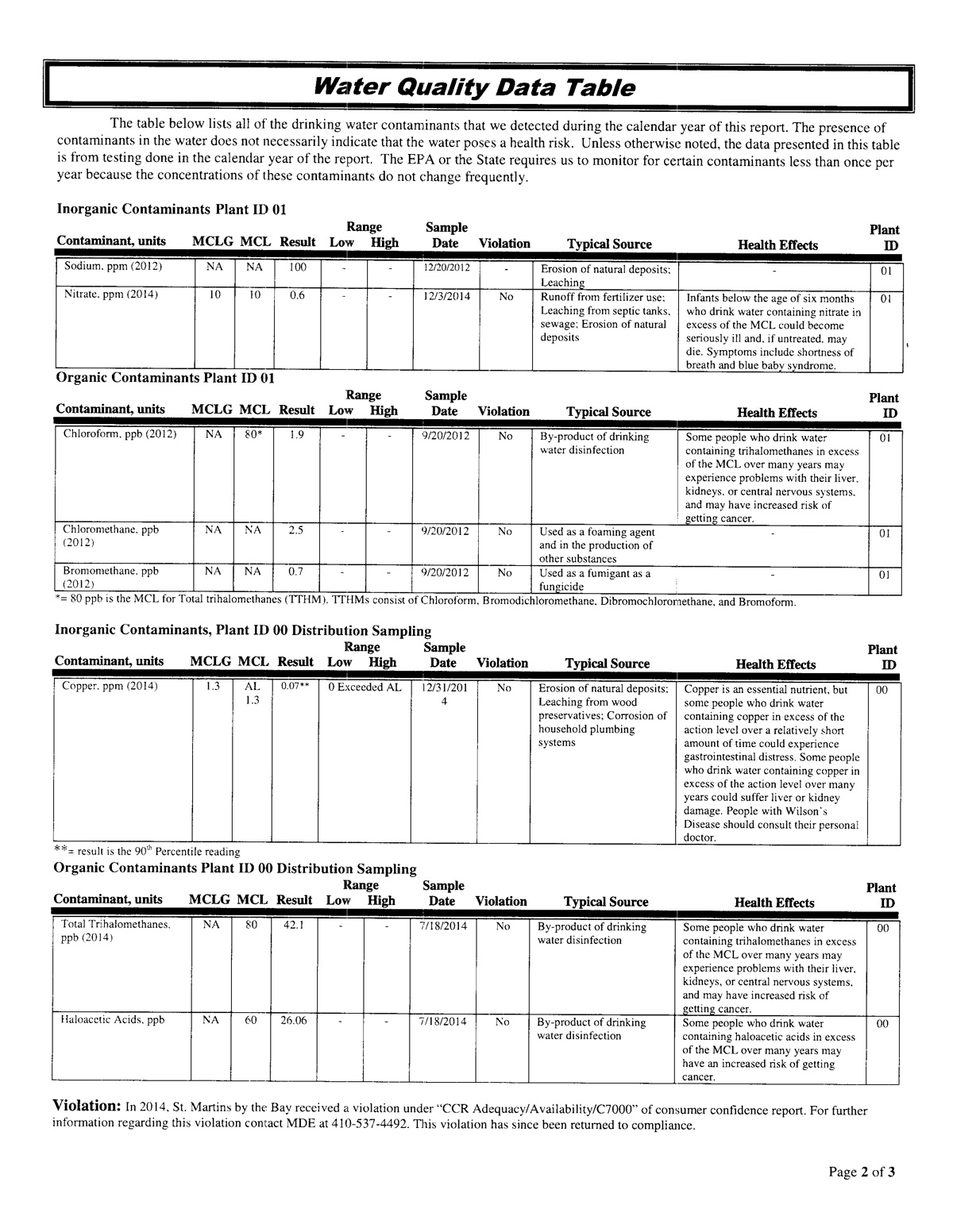
Water Quality Data Table The table below lists all of'the drinking 'water contarninants that we detected during the calendar year of this report. The presence of contaminants in the water does not necessarily inclicate that the water poses a health risk. Unless otherwisr: noted, the data presented in this tabie is fiom testing done in the calenclar year of the report. The EP'A or the State requires us to monitor for certain contaminants less than once per year because the concentrations of Ihese contaminants do not change frequently.
Inorganic Contaminants Plant lft 01 Contaminant units MCLG MCL Range Sample Plant Result Lo'w High Date Violation Typical Source Health Effects ID Sodium. ppm (2012) NA NA 100 12n0/2012 Erosion of natural deposits;
Leachins Nitrate. ppm (2014) l0 l0 0.6 12t3/20t4 No Runoff from fertilizer use:
Leaching from septic tanks.
sewagel Erosion of natural deposits 0l Infants below the age of six months who dnnk water containing nitrate in excess of the MCL could become seriouslv ill and, if untreated. may die. Symptoms include shortness of breath zrnd blue babv syndrome.
0l Organic Contaminants Plant ID 0l .Range Sample Plant Contaminant units MCLG MCI- units MCLG MCI- Result Lorr High Date Violation Typical Source Health Effects ID Chlorofom. ppb (2012) NA 80+ t,9 'st20/2012 No By-product of drinking 0l water disinfection Some people who drink water containing trihalomethanes in excess of the MCL over many years may experience problems with their liver, kidneys. or central nervous s) stems.
and may have increased risk of eettins cancer.
Chloromethane. ppb (201 2) NA L:, 9120t201 No Used as a foaming agent and in the production of other substances Bromonrethane. ppb (201 2) NA NA 0.7 9/20/2012 No Used as a fumigant as a f-unsicide *= 80 ppb is the MCL for Total trihalomethanes (T'|HM). TTHMs consist of Chlorolbrm, Bromodichloromethane. Dibrornochlorornethane. ina g-*oform- 0l 0l Inorganic Contaminants, Plant ID 00 Distribul.ion Sampling lRange Sample Plant Contaminanl units MCLG MCI, Result Lory Hieh Date Violation Typical Source Health Effects ID Copper. ppm (2014) 1.3 Al_ 0.07* 0 Exceeded AL t2/3t/201 1.3 1 No Erosion of natural deposits:
Leaching from wood preservatives; Corrosion of household plumbing systems Copper is an cssential nutrient, but some people who drink water containing copper in excess of the action levcl over a relatively short amount of time could experience gastrointestinal distress. Some people who drink watcr containing copper in excess of the action level over many years could suffer liver or kidney damage. People with Wilson's Disease should consuit their personal doctor.
00 **= result is thc 90s Percentile reading Organic Contaminants Plant ID 00 Distribution Sampling llange Sample Plant units MCLG MCL Result Lovy Date Violation Source Health Effects ID Total Trihalomethanes.
ppb (2014) NA EO 4.2.1 -;^8/2014 No By-product of drinking water disinfection llaloacctic Acids. ppb NA 60 26.06 1/tg/ZOt4 No By-product of drinking water disinfection Some people who drink water containing trihalomethanes in excess of thc MCL over many years may experience problcms with their lircr.
kidneys, or central nervous systems.
and may have increased risk of settins cmcer.
Some people who drink water containing haloacetic acids in excess of the MCL over many years may have an increased risk of gettlng cancer.
00 00 Violation: In 2014, St. Martins by the: Bav received zr violarion under information regarding this violation conriact MDE at 410-537 -4492. Tl"ris 'CCR Adequacy/Availability/C7000" of conr;umer conlidence reporr. For further violation has since been returned to comoliance.
Page 2 of3
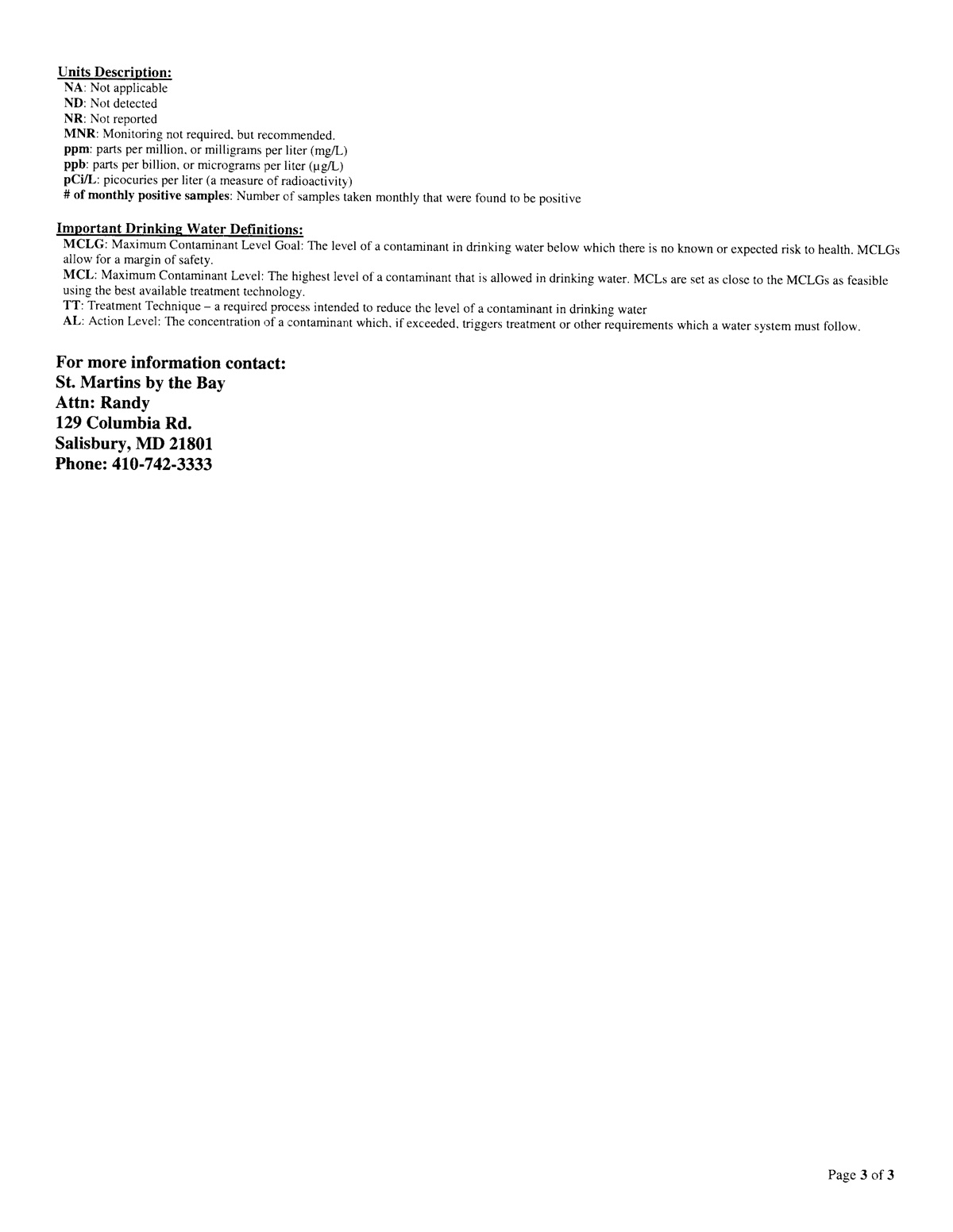
Units Description:
NA: Not applicable ND: Not detected NR: Not reported MNR: Monitoring not requircd. but recorrLmended.
ppm: parts per million. or milligrarns per liter (mg/L) ppb: parts per billion, or micrograrns per litcr (;.rg/L) pCi/L: picocuries per liter (a rneasure of radioactivity) # of monthly positive samples: Number cf samples taken monthly that were found to be positive Important Drinking Water Definitions:
MCLG: Maximum Contaminrant Leve:l Goal: The level of a contaminant in drinking water below which there is no known or expected risk to health. MCLGs allow fbr a miugin of safety.
MCL: Maximum Contarninant Lel'el: The highest level of a contarrLinant that is allowed in drinking water. MCLs are set as close to the MCLGs as feasible using the best available treatment technology.
TT: Treatment Technique - a requirecl process intended to reduce tfLc level of a r:ontaminant in drinking water AL: Action Levcl: The concentrati()n ,rf a :ontaminarrt which. if exceeded, triggors treatment or other requirements which a water system must fbllow. For more information contact:
St. Martins by the Ba1' Attn: Randy 129 Columbia Rd.
Salisbury, MD 21801 Phone: 410-742-3333 Page 3 of 3
Official document
These are the original pages. The PDF file is the same document.