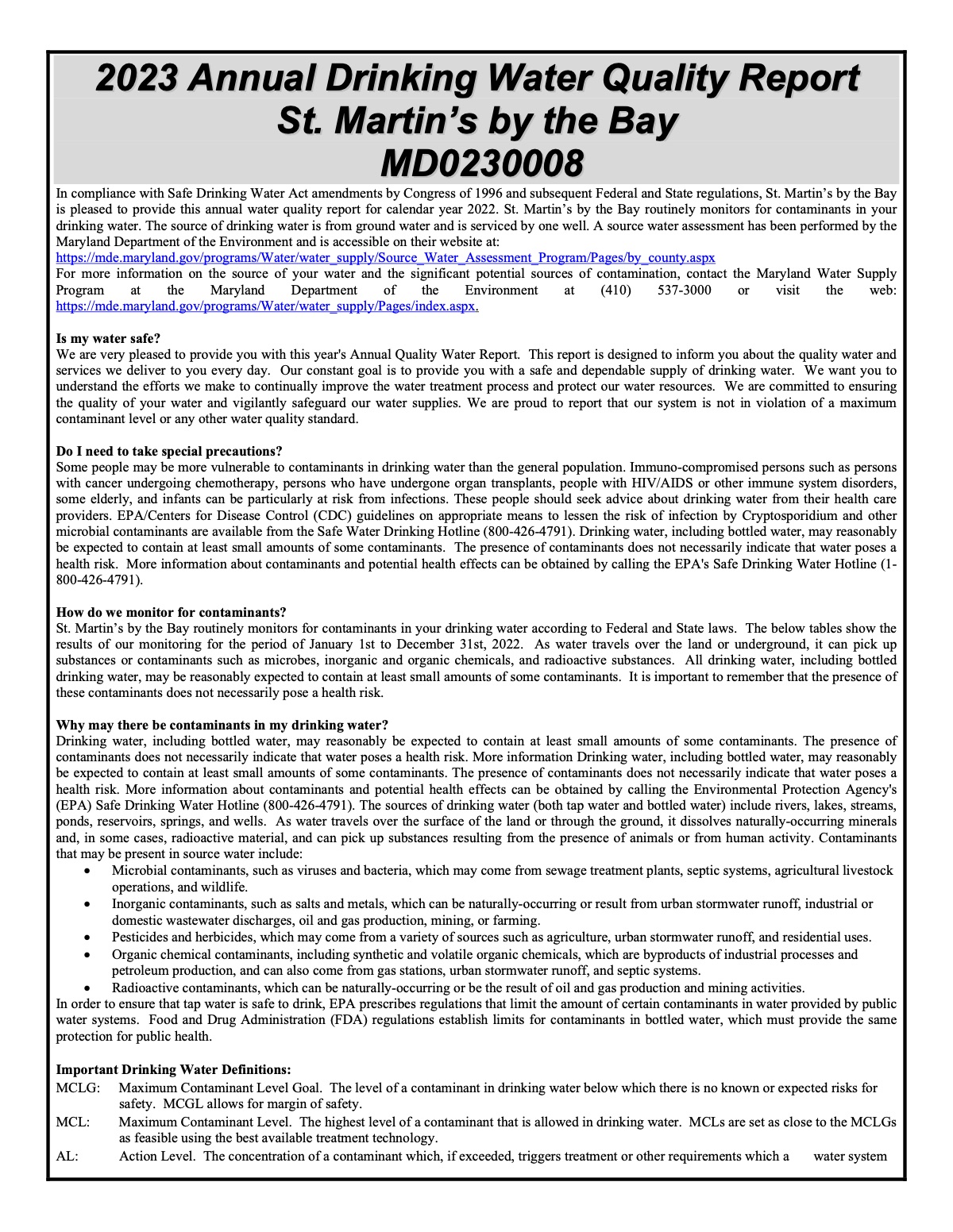
2 20 02 23 3 A An nn nu ua al l S St t. . D Dr ri in nk ki in ng g M Ma ar rt ti in n’ ’s s M MD 02 D0 23 W Wa at te er r b by y t th he e 30 00 00 08 8 Q Qu ua al li it ty y B Ba ay y R Re ep po or rt t In compliance with Safe Drinking Water Act amendments by Congress of 1996 and subsequent Federal and State regulations, St. Martin’s by the Bay is pleased to provide this annual water quality report for calendar year 2022. St. Martin’s by the Bay routinely monitors for contaminants in your drinking water. The source of drinking water is from ground water and is serviced by one well. A source water assessment has been performed by the Maryland Department of the Environment and is accessible on their website at:
https://mde.maryland.gov/programs/Water/water_supply/Source_Water_Assessment_Program/Pages/by_county.aspx For more information on the source of your water and the significant potential sources of contamination, contact the Maryland Water Supply Program at the Maryland Department of the Environment at (410) 537-3000 or visit the web:
https://mde.maryland.gov/programs/Water/water_supply/Pages/index.aspx.
Is my water safe? We are very pleased to provide you with this year's Annual Quality Water Report. This report is designed to inform you about the quality water and services we deliver to you every day. Our constant goal is to provide you with a safe and dependable supply of drinking water. We want you to understand the efforts we make to continually improve the water treatment process and protect our water resources. We are committed to ensuring the quality of your water and vigilantly safeguard our water supplies. We are proud to report that our system is not in violation of a maximum contaminant level or any other water quality standard.
Do I need to take special precautions? Some people may be more vulnerable to contaminants in drinking water than the general population. Immuno-compromised persons such as persons with cancer undergoing chemotherapy, persons who have undergone organ transplants, people with HIV/AIDS or other immune system disorders, some elderly, and infants can be particularly at risk from infections. These people should seek advice about drinking water from their health care providers. EPA/Centers for Disease Control (CDC) guidelines on appropriate means to lessen the risk of infection by Cryptosporidium and other microbial contaminants are available from the Safe Water Drinking Hotline (800-426-4791). Drinking water, including bottled water, may reasonably be expected to contain at least small amounts of some contaminants. The presence of contaminants does not necessarily indicate that water poses a health risk. More information about contaminants and potential health effects can be obtained by calling the EPA's Safe Drinking Water Hotline (1- 800-426-4791).
How do we monitor for contaminants? St. Martin’s by the Bay routinely monitors for contaminants in your drinking water according to Federal and State laws. The below tables show the results of our monitoring for the period of January 1st to December 31st, 2022. As water travels over the land or underground, it can pick up substances or contaminants such as microbes, inorganic and organic chemicals, and radioactive substances. All drinking water, including bottled drinking water, may be reasonably expected to contain at least small amounts of some contaminants. It is important to remember that the presence of these contaminants does not necessarily pose a health risk.
Why may there be contaminants in my drinking water? Drinking water, including bottled water, may reasonably be expected to contain at least small amounts of some contaminants. The presence of contaminants does not necessarily indicate that water poses a health risk. More information Drinking water, including bottled water, may reasonably be expected to contain at least small amounts of some contaminants. The presence of contaminants does not necessarily indicate that water poses a health risk. More information about contaminants and potential health effects can be obtained by calling the Environmental Protection Agency's (EPA) Safe Drinking Water Hotline (800-426-4791). The sources of drinking water (both tap water and bottled water) include rivers, lakes, streams, ponds, reservoirs, springs, and wells. As water travels over the surface of the land or through the ground, it dissolves naturally-occurring minerals and, in some cases, radioactive material, and can pick up substances resulting from the presence of animals or from human activity. Contaminants that may be present in source water include:
Microbial contaminants, such as viruses and bacteria, which may come from sewage treatment plants, septic systems, agricultural livestock operations, and wildlife.
Inorganic contaminants, such as salts and metals, which can be naturally-occurring or result from urban stormwater runoff, industrial or domestic wastewater discharges, oil and gas production, mining, or farming.
Pesticides and herbicides, which may come from a variety of sources such as agriculture, urban stormwater runoff, and residential uses. Organic chemical contaminants, including synthetic and volatile organic chemicals, which are byproducts of industrial processes and petroleum production, and can also come from gas stations, urban stormwater runoff, and septic systems. Radioactive contaminants, which can be naturally-occurring or be the result of oil and gas production and mining activities. In order to ensure that tap water is safe to drink, EPA prescribes regulations that limit the amount of certain contaminants in water provided by public water systems. Food and Drug Administration (FDA) regulations establish limits for contaminants in bottled water, which must provide the same protection for public health.
Important Drinking Water Definitions:
MCLG: Maximum Contaminant Level Goal. The level of a contaminant in drinking water below which there is no known or expected risks for safety. MCGL allows for margin of safety.
MCL: Maximum Contaminant Level. The highest level of a contaminant that is allowed in drinking water. MCLs are set as close to the MCLGs as feasible using the best available treatment technology.
AL: Action Level. The concentration of a contaminant which, if exceeded, triggers treatment or other requirements which a water system
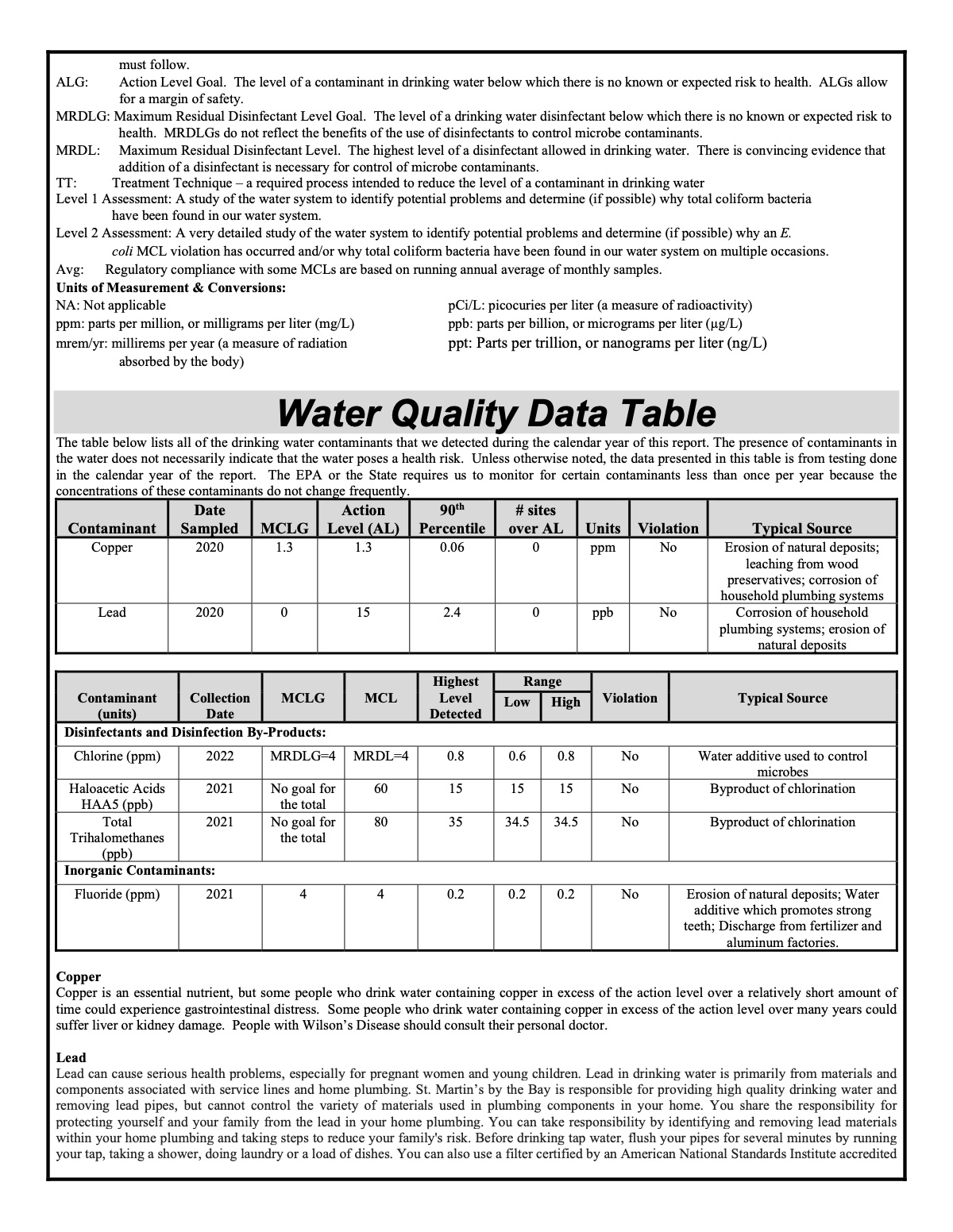
must follow.
ALG: Action Level Goal. The level of a contaminant in drinking water below which there is no known or expected risk to health. ALGs allow for a margin of safety.
MRDLG: Maximum Residual Disinfectant Level Goal. The level of a drinking water disinfectant below which there is no known or expected risk to health. MRDLGs do not reflect the benefits of the use of disinfectants to control microbe contaminants. MRDL: Maximum Residual Disinfectant Level. The highest level of a disinfectant allowed in drinking water. There is convincing evidence that addition of a disinfectant is necessary for control of microbe contaminants.
TT: Treatment Technique – a required process intended to reduce the level of a contaminant in drinking water Level 1 Assessment: A study of the water system to identify potential problems and determine (if possible) why total coliform bacteria have been found in our water system.
Level 2 Assessment: A very detailed study of the water system to identify potential problems and determine (if possible) why an E. coli MCL violation has occurred and/or why total coliform bacteria have been found in our water system on multiple occasions. Avg: Regulatory compliance with some MCLs are based on running annual average of monthly samples. Units of Measurement & Conversions:
NA: Not applicable ppm: parts per million, or milligrams per liter (mg/L) mrem/yr: millirems per year (a measure of radiation pCi/L: picocuries per liter (a measure of radioactivity) ppb: parts per billion, or micrograms per liter (µg/L) ppt: Parts per trillion, or nanograms per liter (ng/L) absorbed by the body) Water Quality Data Table The table below lists all of the drinking water contaminants that we detected during the calendar year of this report. The presence of contaminants in the water does not necessarily indicate that the water poses a health risk. Unless otherwise noted, the data presented in this table is from testing done in the calendar year of the report. The EPA or the State requires us to monitor for certain contaminants less than once per year because the concentrations of these contaminants do not change frequently.
Date Action 90th # sites Contaminant Sampled MCLG Level (AL) Percentile over AL Units Violation Typical Source Copper 2020 1.3 1.3 0.06 0 ppm No Erosion of natural deposits;
leaching from wood preservatives; corrosion of household plumbing systems Lead 2020 0 15 2.4 0 ppb No Corrosion of household plumbing systems; erosion of natural deposits Contaminant Collection MCLG MCL Highest Level Range Low High Violation Typical Source (units) Date Detected Disinfectants and Disinfection By-Products:
Chlorine (ppm) 2022 MRDLG=4 MRDL=4 0.8 0.6 0.8 No Water additive used to control microbes Haloacetic Acids HAA5 (ppb) Total Trihalomethanes (ppb) 2021 No goal for the total 60 15 15 15 No Byproduct of chlorination 2021 No goal for the total 80 35 34.5 34.5 No Byproduct of chlorination Inorganic Contaminants:
Fluoride (ppm) 2021 4 4 0.2 0.2 0.2 No Erosion of natural deposits; Water additive which promotes strong teeth; Discharge from fertilizer and aluminum factories.
Copper Copper is an essential nutrient, but some people who drink water containing copper in excess of the action level over a relatively short amount of time could experience gastrointestinal distress. Some people who drink water containing copper in excess of the action level over many years could suffer liver or kidney damage. People with Wilson’s Disease should consult their personal doctor. Lead Lead can cause serious health problems, especially for pregnant women and young children. Lead in drinking water is primarily from materials and components associated with service lines and home plumbing. St. Martin’s by the Bay is responsible for providing high quality drinking water and removing lead pipes, but cannot control the variety of materials used in plumbing components in your home. You share the responsibility for protecting yourself and your family from the lead in your home plumbing. You can take responsibility by identifying and removing lead materials within your home plumbing and taking steps to reduce your family's risk. Before drinking tap water, flush your pipes for several minutes by running your tap, taking a shower, doing laundry or a load of dishes. You can also use a filter certified by an American National Standards Institute accredited
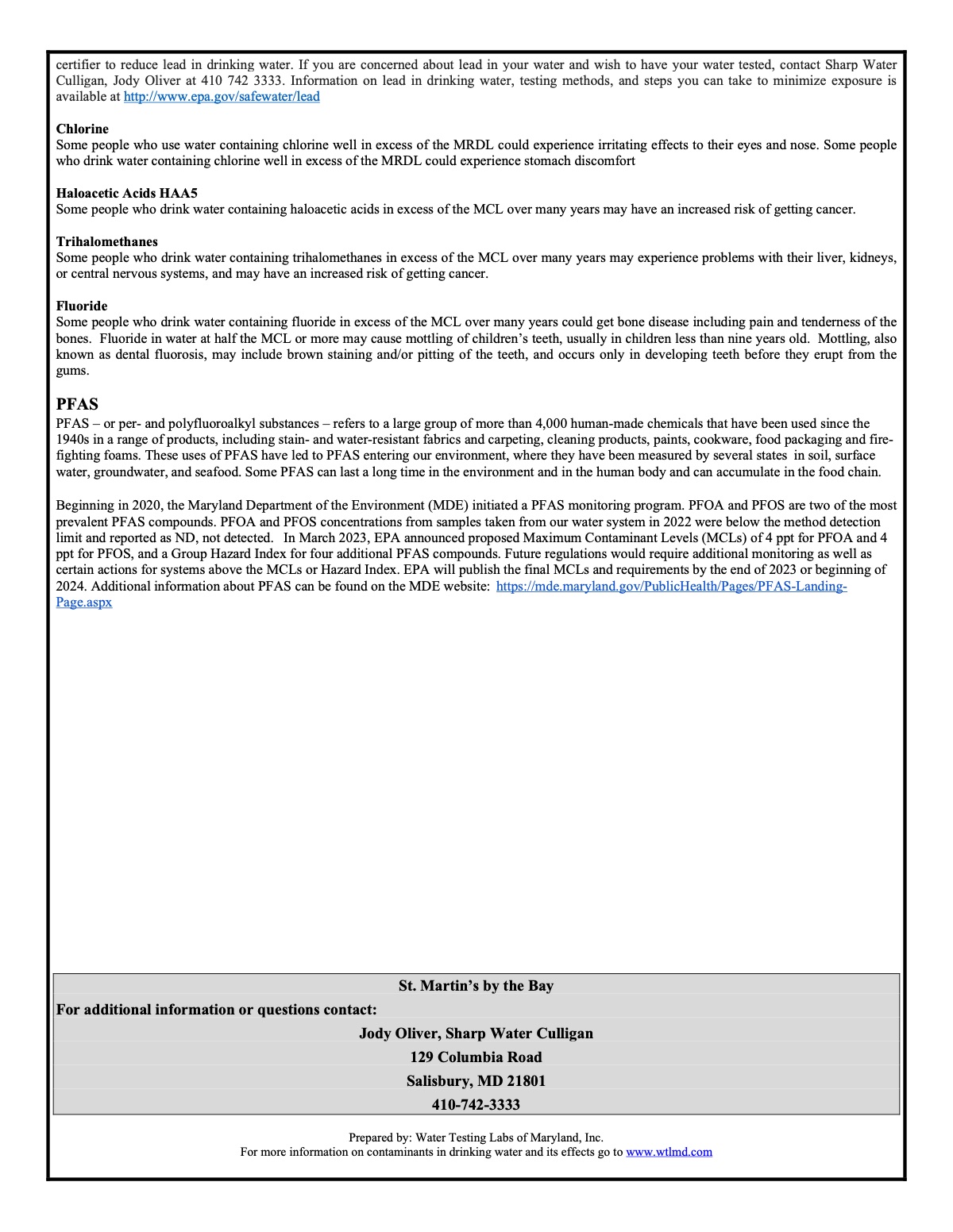
certifier to reduce lead in drinking water. If you are concerned about lead in your water and wish to have your water tested, contact Sharp Water Culligan, Jody Oliver at 410 742 3333. Information on lead in drinking water, testing methods, and steps you can take to minimize exposure is available at http://www.epa.gov/safewater/lead Chlorine Some people who use water containing chlorine well in excess of the MRDL could experience irritating effects to their eyes and nose. Some people who drink water containing chlorine well in excess of the MRDL could experience stomach discomfort Haloacetic Acids HAA5 Some people who drink water containing haloacetic acids in excess of the MCL over many years may have an increased risk of getting cancer. Trihalomethanes Some people who drink water containing trihalomethanes in excess of the MCL over many years may experience problems with their liver, kidneys, or central nervous systems, and may have an increased risk of getting cancer.
Fluoride Some people who drink water containing fluoride in excess of the MCL over many years could get bone disease including pain and tenderness of the bones. Fluoride in water at half the MCL or more may cause mottling of children’s teeth, usually in children less than nine years old. Mottling, also known as dental fluorosis, may include brown staining and/or pitting of the teeth, and occurs only in developing teeth before they erupt from the gums.
PFAS PFAS – or per- and polyfluoroalkyl substances – refers to a large group of more than 4,000 human-made chemicals that have been used since the 1940s in a range of products, including stain- and water-resistant fabrics and carpeting, cleaning products, paints, cookware, food packaging and fire- fighting foams. These uses of PFAS have led to PFAS entering our environment, where they have been measured by several states in soil, surface water, groundwater, and seafood. Some PFAS can last a long time in the environment and in the human body and can accumulate in the food chain. Beginning in 2020, the Maryland Department of the Environment (MDE) initiated a PFAS monitoring program. PFOA and PFOS are two of the most prevalent PFAS compounds. PFOA and PFOS concentrations from samples taken from our water system in 2022 were below the method detection limit and reported as ND, not detected. In March 2023, EPA announced proposed Maximum Contaminant Levels (MCLs) of 4 ppt for PFOA and 4 ppt for PFOS, and a Group Hazard Index for four additional PFAS compounds. Future regulations would require additional monitoring as well as certain actions for systems above the MCLs or Hazard Index. EPA will publish the final MCLs and requirements by the end of 2023 or beginning of 2024. Additional information about PFAS can be found on the MDE website: https://mde.maryland.gov/PublicHealth/Pages/PFAS-Landing- Page.aspx St. Martin’s by the Bay For additional information or questions contact:
Jody Oliver, Sharp Water Culligan 129 Columbia Road Salisbury, MD 21801 410-742-3333 Prepared by: Water Testing Labs of Maryland, Inc.
For more information on contaminants in drinking water and its effects go to www.wtlmd.com
Official document
These are the original pages. The PDF file is the same document.