Pages that were photographs or scans were read and written out below. The original file is unchanged.
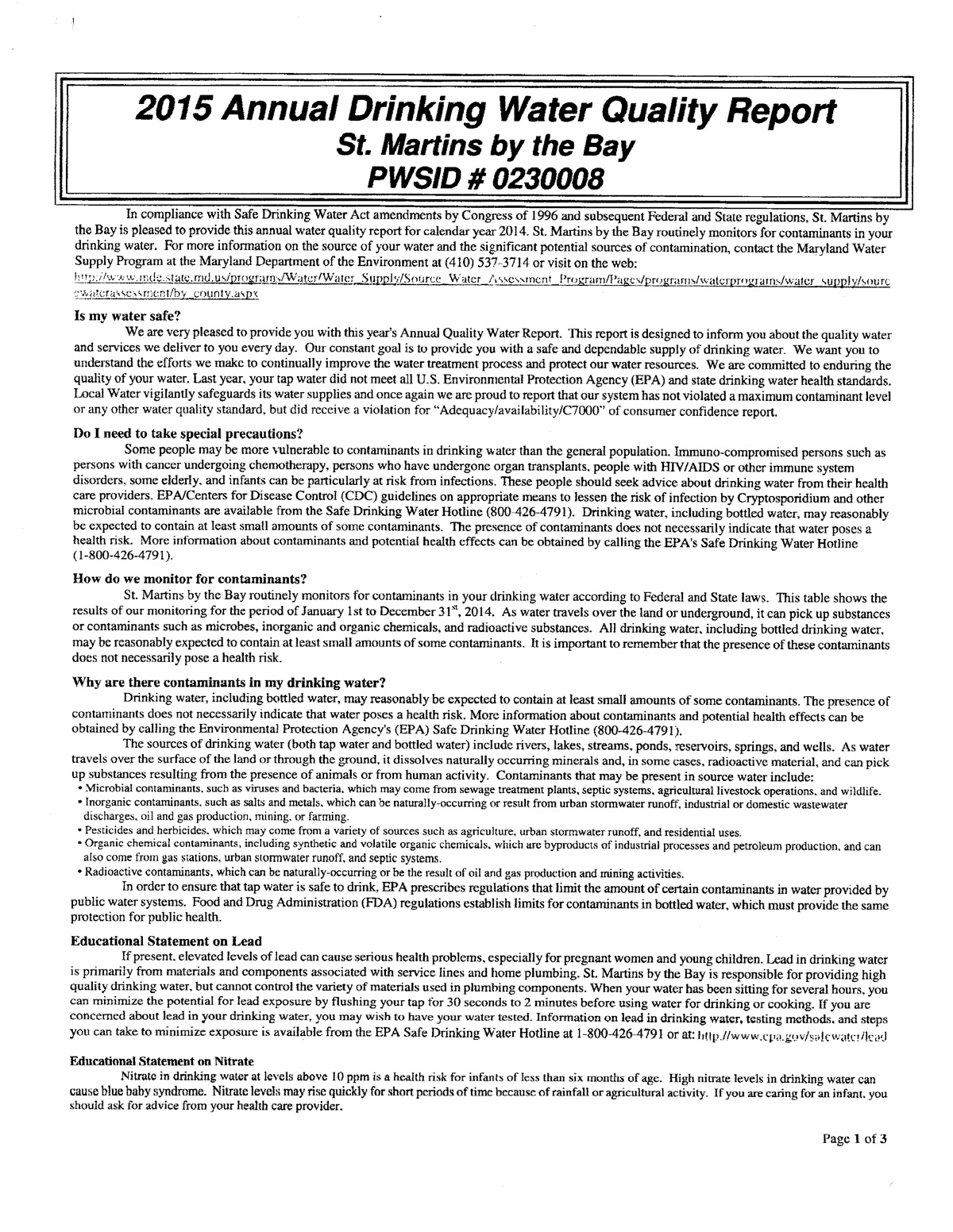
2015 Annual Drinking Water Quality Report St. Martins by the Bay PWSID # 0230008 In compliance with Safe Drinking Water Act amendments by Congress of 1996 and subsequent Federal and State regulations, St. Martins by the Bay is pleased to provide this annual water quality report for calendar ycar 2014. St. Martins by the Bay routinely monitors for contaminants in your drinking water. For more information on the source of your water and the significant potential sources of contamination, contact the Maryland Water Supply Program at the Maryland Department of the Environment at (410) 537-3714 or visit on the web: htttp://www.mde.state.md.us/prosram:/Watcr/Water_Supply/Source Watcr_/Assessment_Program/Pages/programs/waterprograms/water_supply/sourc ewatcrasscasment/by_county.aspx Is my water safe? We are very pleased to provide you with this year's Annual Quality Water Report. This report is designed to inform you about the quality water and services we deliver to you every day.
Our constant goal is to provide you with a safe and dependable supply of drinking water. We want you to understand the efforts we make to continually improve the water treatment process and protect our water resources. We are committed to enduring the quality of your water. Last year, your tap water did not meet all U.S. Environmental Protection Agency (EPA) and state drinking water health standards. Local Water vigilantly safeguards its water supplies and once again we are proud to report that our system has not violated a maximum contaminant level or any other water quality standard, but did receive a violation for "Adequacy/availability/C7000" of consumer confidence report. Do I need to take special precautions? Some people may be more vulnerable to contaminants in drinking water than the general population. Immuno-compromised persons such as persons with cancer undergoing chemotherapy, persons who have undergone organ transplants, people with HIV/AIDS or other immune system disorders, some elderly. and infants can be particularly at risk from infections. These people should seek advice about drinking water from their health care providers. EPA/Centers for Disease Control (CDC) guidelines on appropriate means to lessen the risk of infection by Cryptosporidium and other microbial contaminants are available from the Safe Drinking Water Hotline (800-426-4791). Drinking water, including bottled water, may reasonably be expected to contain at least small amounts of some contaminants. The presence of contaminants does not necessarily indicate that water poses a health risk. More information about contaminants and potential health effects can be obtained by calling the EPA's Safe Drinking Water Hotline (1-800-426-4791).
How do we monitor for contaminants? St. Martins by the Bay routinely monitors for contaminants in your drinking water according to Federal and State laws. This table shows the results of our monitoring for the period of January 1st to December 31", 2014. As water travels over the land or underground, it can pick up substances or contaminants such as microbes, inorganic and organic chemicals, and radioactive substances. All drinking water, including bottled drinking water, may be reasonably expected to contain at least small amounts of some contaminants. It is important to remember that the presence of these contaminants does not necessarily pose a health risk.
Why are there contaminants in my drinking water? Drinking water, including bottled water, may reasonably be expected to contain at least small amounts of some contaminants. The presence of contaminants does not necessarily indicate that water poses a health risk. More information about contaminants and potential health effects can be obtained by calling the Environmental Protection Agency's (EPA) Safe Drinking Water Hotline (800-426-4791). The sources of drinking water (both tap water and bottled water) include rivers, lakes, streams, ponds, reservoirs, springs, and wells. As water travels over the surface of the land or through the ground, it dissolves naturally occurring minerals and, in some cases, radioactive material, and can pick up substances resulting from the presence of animals or from human activity. Contaminants that may be present in source water include:
- Microbial contaminants. such as viruses and bacteria, which may come from sewage treatment plants, septic systems. agricultural livestock operations, and wildlife.
- Inorganic contaminants. such as salts and metals, which can be naturally-occurring or result from urban stormwater runoff, industrial or domestic wastewater discharges, oil and gas production, mining. or farming.
Perinides anil bondes, which may ding from and yof sources such as nigi lure ute yprodets of dustind processes and petroleum production, and can also come from gas stations, urban stormwater runoff, and septic systems.
• Radioactive are easy, which an a pataly ouri presides i do poutin and man circetain contaminants in water provided by public water systems. Food and Drug Administration (FDA) regulations establish limits for contaminants in bottled water, which must provide the same protection for public health.
If present. elevated levels of lead can cause serious health problems, especially for pregnant women and young children. Lead in drinking water concerned about lead in your drinking water, you may wish to have your water tested. Information on lead in drinking water, testing methods. and steps you can take to minimize exposure is available from the EPA Safe Drinking Water Hotline at 1-800-426 4791 or at: http.//www.cpa.gov/salewater/lead Educational Statement on Nitrate Nitrate in drinking water at levels above 10 ppm is a health risk for infants of less than six months of age. High nitrate levels in drinking water can cause blue baby syndrome. Nitrate levels may rise quickly for short periods of time because of rainfall or agricultural activity. If you are caring for an infant. you should ask for advice from your health care provider.
Page 1 of 3
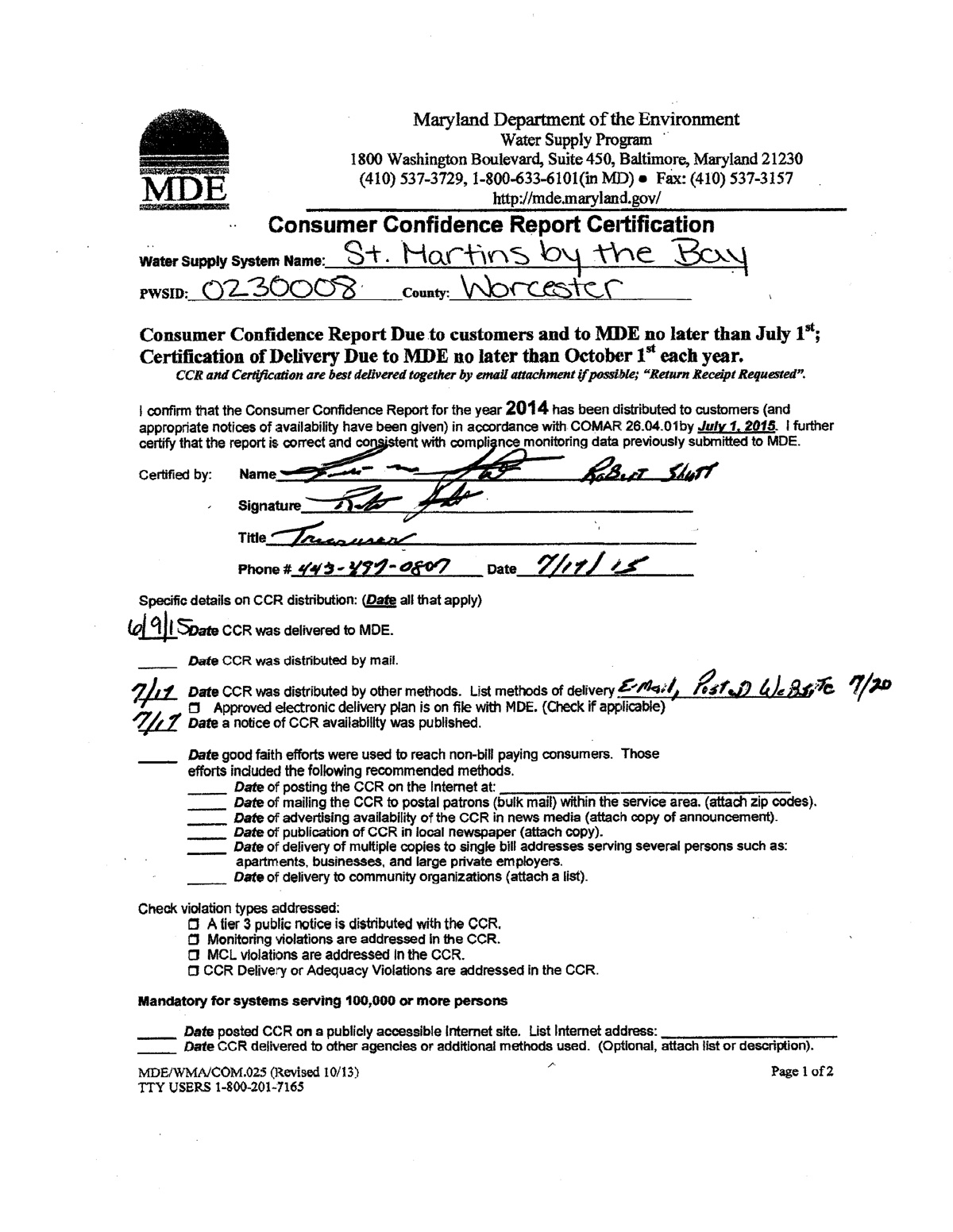
Maryland Department of the Environment Water Supply Program 1800 Washington Boulevard, Suite 450, Baltimore, Maryland 21230 MDE (410) 537-3729, 1-800-633-6101(in MID) • Fax: (410) 537-3157 http://mde.maryland.gov/ Consumer Confidence Report Certification Water suply System Name: St. Martins by the Bay PWSID:_ 0230008 _County: Worcester Consumer Confidence Report Due to customers and to MDE no later than July 1*t;
Certification of Delivery Due to MIDE no later than October 1° each year.
CCR and Certification are best delivered together by email attachment if possible; "Return Receipt Requested". I confirm that the Consumer Confidence Report for the year 2014 has been distributed to customers (and appropriate notices of availability have been given in accordance with COMAR 26.04.01by July 1, 2015. I further certify that the report is correct and consistent with compliance monitoring data previously submitted to MDE. Certified by:
Name DoBert Short Signature" 5b f Title Tressusert Phone # 443-492-0807 _ Date Specific details on CCR distribution: (Date all that apply) 119/15 pate CCR was delivered to MDE.
Date CCR was distributed by mail.
- 7/12 Date CCR was distributed by other methods. List methods of delivery E Mail, PosteD Westite 1/20
- Approved electronic delivery plan is on file with MDE. (Check if applicable) 7/1Z Date a notice of CCR availabilty was published.
Date good faith efforts were used to reach non-bill paying consumers. Those efforts included the following recommended methods.
Date of posting the CCR on the Internet at:
Date of mailing the CCR to postal patrons (bulk mail) within the service area. (attach zip codes). Date of advertising availability of the CCR in news media (attach copy of announcement) Date of publication of CCR in local newspaper (attach copy) Date of delivery of multiple copies to single bill addresses serving several persons such as apartments, businesses, and large private employers.
Date of delivery to community organizations (attach a list).
Check violation types addressed:
• A tier 3 public notice is distributed with the CCR.
• Monitoring violations are addressed in the CCR.
• MCL violations are addressed in the CCR.
• CCR Delivery or Adequacy Violations are addressed in the CCR.
Mandatory for systems serving 100,000 or more persons Date posted CCR on a publicly accessible Internet site. List Internet address:
Date CCR delivered to other agencies or additional methods used. (Optional, attach list or description). MDE/WMA/COM.025 (Revised 10/13) Page 1 of 2 TTY USERS 1-800-201-7165
Official document
These are the original pages. The PDF file is the same document.